

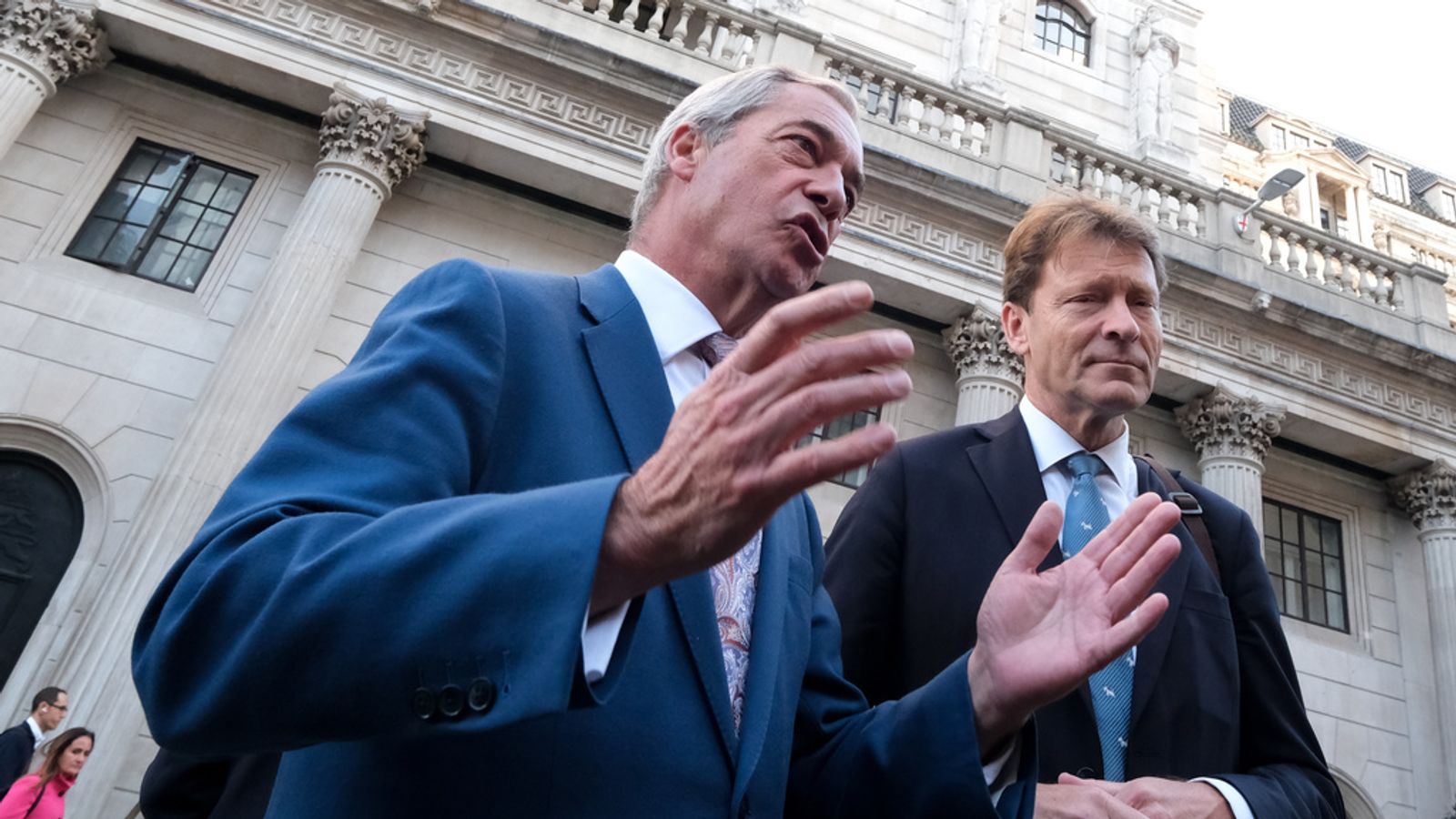
There was some hypothesis, when it emerged that Nigel Farage was heading to Threadneedle Road to see the Financial institution of England governor, that he was about to “do a Trump”.
You would possibly recall, if you happen to observe American politics, how the US president has been, for need of a greater phrase, trolling the chairman of the Federal Reserve, Jerome Powell, threatening to fireplace him if he did not lower rates of interest. Would possibly Mr Farage and Reform be about to do the identical factor within the UK, elevating deep (and, for economists, scary) questions concerning the independence of the central financial institution?
The brief reply, so far as anybody can inform following in the present day’s assembly, is: no. As a substitute, Mr Farage and his fellow Reform MP Richard Tice loved a comparatively cordial assembly with the governor, the place they mentioned the intricacies of quantitative easing, the Financial institution’s reserves insurance policies and even cryptocurrency – a barely surprising addition to the agenda which could mirror the truth that Reform is hoping to lift plenty of marketing campaign funds from crypto dudes.
Cash newest: HMRC can now take cash direct out of your account if you happen to do not pay
The principle Financial institution-related problem Reform has been campaigning on – Mr Tice particularly – comes again to one thing seemingly arcane however actually necessary. As you could bear in mind, lately, the Financial institution of England has, alongside its rate of interest coverage, been engaged in one thing known as quantitative easing (QE). QE is complicated, but it surely boils right down to this: in an effort to spice up the economic system, the Financial institution purchased up a whole lot of authorities bonds and so they now sit awkwardly in its stability sheet. In latest months, the Financial institution has begun to reverse QE (quantitative tightening) – promoting off billions of kilos of bonds.
Anyway, attain deeper into the arcane mechanism of how QE works and one thing fascinating leaps out. Two issues, truly. First, as a part of QE, with a purpose to pay money for these authorities bonds, the Financial institution created “reserves” – type of bank-account-at-the-Financial institution-of-England – for the excessive road banks from whom it purchased them.
Tens of billions to excessive road banks
These reserves earn curiosity on the Financial institution’s official rate of interest. On the time of QE, the speed was close to zero, so nobody spent a lot time occupied with reserves. However since then, charges went as much as 5.25%, and at the moment are at 4%, and therefore the Financial institution has lately been paying out a hefty quantity – tens of billions of kilos – in curiosity to excessive road banks.

Reform UK chief Nigel Farage (left) and deputy chief Richard Tice talking to the media outdoors the Financial institution Of England in central London. Pic: PA
This, says Richard Tice, is an abomination. Within the final Reform manifesto, he stated the Financial institution ought to cease paying out these reserves. Which, on the face of it, sounds completely wise. Nevertheless, there are a number of catches.
An enormous financial institution tax
The primary is that whereas in principle it would assist recoup billions of kilos of public cash, that cash has to come back from someplace, and on this case, it will come from excessive road banks. In different phrases, that is, in all however identify, a really huge financial institution tax. The Financial institution of England’s level, when requested about all this, is that if anybody goes to do one thing like that, it ought to actually be the federal government, because it’s rightly in command of taxing and spending.
Learn extra:
Co-op reveals £80m revenue hit from cyber assault disruption – with extra to come back
Jaguar Land Rover cyber assault: No simple choices for taxpayer support
The opposite catch is that Financial institution of England reserves methods are desperately complicated. Altering the way in which they’re structured is a fragile operation. Working a coach and horses by way of it, as Mr Tice is suggesting, may have all kinds of unintended penalties, together with undermining confidence in UK financial coverage.
This, by the way in which, shouldn’t be the one factor Reform is sad about: in addition they assume the Financial institution ought to decelerate its quantitative tightening programme.
However the level of all of the above is that whereas there are some huge query marks concerning the explicit concept Reform is proposing, the worst factor of all could be to not focus on this as publicly as doable.
The worst end result of all could be for the federal government and Financial institution to take sure choices which have an effect on billions of kilos of public cash with solely the merest of scrutiny, save on the Treasury Choose Committee, whose periods not often get a lot consideration past the monetary pages. And that is kind of the state of affairs we have had for the previous decade and a half.
The Financial institution of England has launched probably the most radical financial experiments in historical past, which can or could not have been successful or a failure, however few outdoors of the Metropolis are even conscious of it. Mr Tice’s coverage platform could also be flawed, however his overarching level – that these items desperately wants extra scrutiny – is sort of proper.