

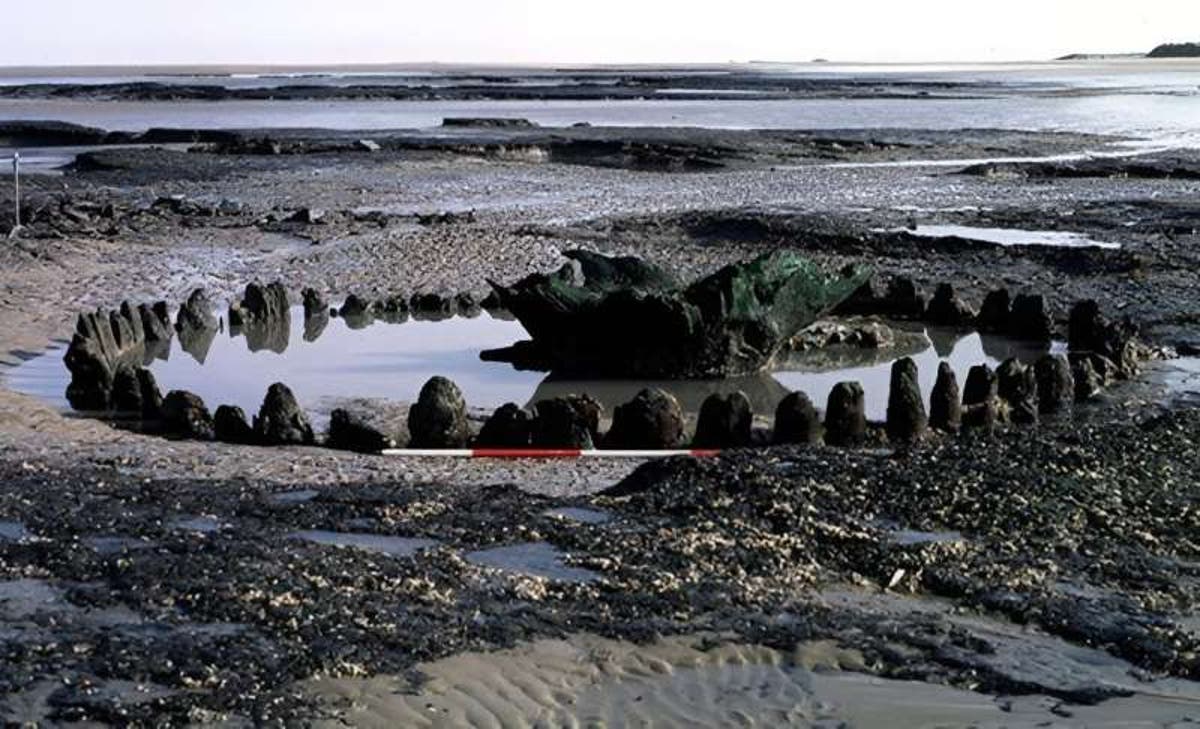
A 4,000-year-old timber circle on a Norfolk seashore dubbed the “Seahenge” was constructed after a interval of maximum local weather degradation on the shut of the third millennium BC, a brand new research has discovered.
The mysterious historical construction was first revealed in 1998 by the shifting sands of Holme-next-the-sea seashore on the north Norfolk coast.
It consists of an upturned tree stump surrounded by 55 carefully fitted oak posts and was initially constructed on the salt marsh away from the ocean.
Researchers estimate it to have been constructed utilizing timbers relationship from 2049 BC.
The unusual construction was positioned such that dunes and dirt flats protected it from the ocean.
A layer of peat which slowly coated the timbers additionally protected them from decay over 1000’s of years. There’s a second, adjoining ring centred on two oak logs laid flat, which can be dated to the identical yr.
Earlier analysis hypothesised that the buildings could have been erected to mark the dying of a person.
Different theories prompt they have been used for particular sky burials through which the useless can be positioned inside to be pecked and carried away by carrion-eating birds.
Now, a brand new paper concludes that the Seahenge and the adjoining circle could have been constructed throughout a bitterly chilly climatic interval as a ritual to increase the summer season and return to hotter climate.
“Courting of Seahenge timbers confirmed they have been felled in spring, and it was thought-about most possible that these timbers have been aligned with dawn on the summer season solstice,” archaeologist David Nance from the College of Aberdeen stated.
“We all know that the interval through which they have been constructed 4,000 years in the past was a protracted interval of decreased atmospheric temperatures and extreme winters and late springs putting these early coastal societies below stress,” he stated.
The Seahenge’s alignment matches with dawn on the summer season solstice, suggesting it mimicked the “pen” described in folklore for an unfledged cuckoo to maintain singing and prolong the summer season.
Archaeologists suspect that the unusual monument’s construction imitates the winter dwellings of the cuckoo remembered in folklore – a hole tree or ‘the bowers of the Otherworld’ represented by the upturned oak stump at its middle.
“Summer time solstice was the date when in response to folklore the cuckoo, symbolising fertility, historically stopped singing, returned to the Otherworld and the summer season went with it,” Dr Nance defined.
“The ritual is remembered within the ‘delusion of the pent cuckoo’ the place an unfledged cuckoo was positioned right into a thorn bush and the chicken was ‘walled-in’ to increase the summer season however it at all times flew away,” he stated.
The opposite construction, in response to Dr Nance, factors to legends of ‘sacred kings’ who have been sacrificed if misfortune fell on the neighborhood.
“Proof means that they have been ritually sacrificed each eight years at Samhain (now Halloween) coincident with the eight-year cycle of Venus,” he stated.
“Each monuments are finest defined as having totally different features and related rituals, however with a typical intent: to finish the severely chilly climate,” Dr Nance stated.